A gate, not a kill switch
Cutting off a device that should not be streaming is the easy half. The hard half is making sure it cannot come back — and that is a different mechanism.
Every platform that streams from hardware eventually needs to stop one. A device is sold, a contract lapses, a key leaks, a camera moves to a customer who no longer pays for it. The obvious answer is a kill switch: find the live session, tear it down, done.
The obvious answer is also the half that does not hold. A device whose session you tore down is a device that reconnects four seconds later.
Two mechanisms doing two jobs
We separate them deliberately.
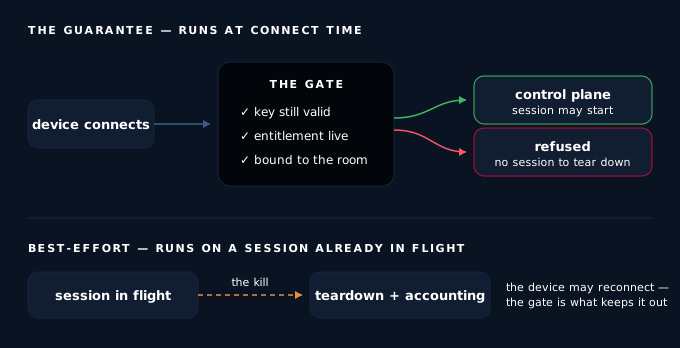
- The gate runs when a device connects. Before a device is allowed onto the control plane at all, it is checked: is this key still valid, does this Organization still have an entitlement, is this device still bound to a room it may serve. A device that fails is not connected, so there is no session to tear down.
- The kill is what happens to a session already in flight. It publishes a disconnect on the control channel and cleans up the accounting behind it.
The kill is cooperative and best-effort. The gate is the guarantee.
Why this shows up in the product
Because the gate runs at connect time and reads current state, the things an operator actually does — deactivating a device, rotating a key, moving a camera out of a room, cancelling a plan — take effect without anyone chasing sessions around the network. The enforcement point is one place, and it is the place every device has to pass through anyway.
It also means the guarantee does not depend on the broker. Kicking a live session is a broker-specific capability and not every broker has one; refusing a connection is something every broker does, because it is the thing brokers are for.
The part that is genuinely harder
A device that is mid-move is live in the room it actually reached, not the room you last told it to go to. Those two can differ for as long as it takes a device on a patchy link to acknowledge an instruction — which on a truck, a boat, or a construction site can be a while.
So a disconnect has to target where the session really is. Aiming at where the device was supposed to be produces the worst possible outcome: an operation that reports success and changes nothing.